


London Marathon 2026 - 2:41:10 and Eyes on 2:39:xx
Updated: May 6
This time last year, I wrote a post reflecting on my 2:44:02 marathon just before my 45th birthday at London Marathon, as part of Puma Project3. It was one of those races where a couple of years of good consistency really paid off along with the support of a top brand. But let’s be honest, as runners, the minute we cross the line and catch our breath, we’re already moving the goalposts.
This time around, having followed a 1 marathon race (with the exception of regular pacing at Belfast Marathon) a year strategy (a change from a few years ago where I'd do 2-4), I headed back to London in April, again as a GFA qualifier, feeling motivated with a new improved target in my head. Mainly because I felt was in equally as good shape for this one, if not a bit stronger as I was in April 2025. Also, the weather forecasted didn't look anywhere near as hot as the previous year's race in London. I’m still buzzing that I crossed the line in 2:41:10.
To be out on the course the same day Sabastian Sawe broke the two-hour barrier and Tigst Assefa lowered her Women's only (which is basically without male pacemakers) world record was incredibly special. Add in a record-breaking 59,830 finishers and £87.5 million raised for charity, and you get a sense of the scale of the day. The buzz on the streets, the massive crowds, and the world-class support were just out of this world, as London always is. Here’s a look at how the training block actually went, the shifts I made in my fueling, how the miles unfolded, and a light-hearted post-race moment I’ll never forget.
The Build-Up: Managing the Load & Dodging Curveballs
If you read my last recap, you’ll know I think I respond well to consistent mileage building and more threshold and sub threshold running, with just a sprinkle of speed work. For this block, I followed a 17-week progressive plan, floating between 75 and 90 miles a week, with load and intensity periodisation built in, largely based on the Pfitzinger and Douglas Advanced Marathoning Plan. This was made possible, as is often the case, by the work in 2025, logging consistent 60+ mile weeks from the summer onwards, with more intensity, as my focus in the 2nd half of 2025 was half marathon and 10k, which resulted in personal best performances in both distances.
To handle that kind of volume without trashing my legs, I leaned into some double days. Breaking up the miles made a massive difference. I also tweaked my strength work, keeping it "little and often" and mainly core-based, rather than lifting heavy and carrying dead legs into my key running sessions.
But it definitely wasn't all smooth sailing, and I take a huge amount of pride in just getting to the start line healthy; the main goal and fear that all marathoners in particular, share. This block like us all in the UK / NI / Ireland training for spring marathons, meant lacing up and grinding through the absolute worst winter weather I can ever remember from ice and snow to what seemed like 3 months of windy and rainy most days. On some days it made sessions impossible and thank goodness for treadmills close to home. Throw in the mental load of a job change in March and the beautiful chaos of getting our second family dog, full time work and my own part-time coaching business, and my plate was pretty full! I'm sure so many of you reading, can relate.
Just to keep things interesting, the training itself threw some hurdles at me: Week 3 brought a nasty back spasm that stopped me in my tracks for 8-9 days. Later on, I got hit with a bout of food poisoning, and I had to juggle the fatigue of a 5-day work trip when still getting through that. Thankfully as the 2nd half of the training block came around, as did my form and consistency.
But that’s real life, isn’t it? Perfection doesn't exist in marathon prep; consistency does. I didn't panic, didn't force missed sessions, and just adapted the plan. Thanks has to go to clubmates and friends at Mallusk Harriers and fellow similar ability runners locally to share some key long runs and sessions with. Banging out those key sessions and ticking off the long miles together made the heavy workload, and that miserable winter weather so much easier to handle than if 100% solo..
The Berlin Boost
A sign that the fitness was bubbling nicely came at the end of March. I raced the Berlin Half Marathon off a very minimal taper, but having banked 6 great back to back weeks, basically running on heavy marathon-training legs. I managed to sneak a 25-second PB, finishing in 76:20. That was a nice confidence booster and proved the engine was firing okay.

Carbs, Carbs, and ALSO... Carbs
I thought got my nutrition mostly right in 2025 London, but to try and tap into some potential marginal gains, I thought I had to get more aggressive and intentional. The science is pointing toward larger carbohydrate intake during races, so I went at it a bit more aggressively.
The Load: 1,400g of carbs spread across the 2 days before the race.
Race Morning: 190g of carbs before the gun even went off.
During the Race: 240g of carbs, via gels, plus 5 salt capsules and 5 bottles of water to keep the cramps away.
The result? My energy levels felt pretty solid the whole way round. When the race really started to bite in the last 10K, the tank wasn't empty.
The Holy Grail: A Negative Split
Last year, the heat meant I had to settle for a slight positive split. This year, my eyes were firmly on a negative split. I broke it down in my head: go out in 1:20:45, come back in 1:20:35. Thanks to the fuelling strategy and the wall of noise from the London crowds, I felt in control. I went through the halfway mark in 1:20:42 and managed to wind up the pace perfectly to bring the second half home in 1:20:28. Pulling off a negative split in a marathon is a rare, beautiful feeling. Taking nearly three minutes off last year's PB and crossing in 2:41:10... everything just clicked. As for the race itself I genuinely felt in control the whole way, checking in with myself continually. Last year's muscle memory and course knowledge I think helped more than I thought it would, and I knew from around halfway, that from an energy perspective and marathon experiences in the past that if I stuck to my pacing and fuelling strategy, I'd have a strong shout at a progressively faster finish.

A Surreal Post-Race pint Substitute
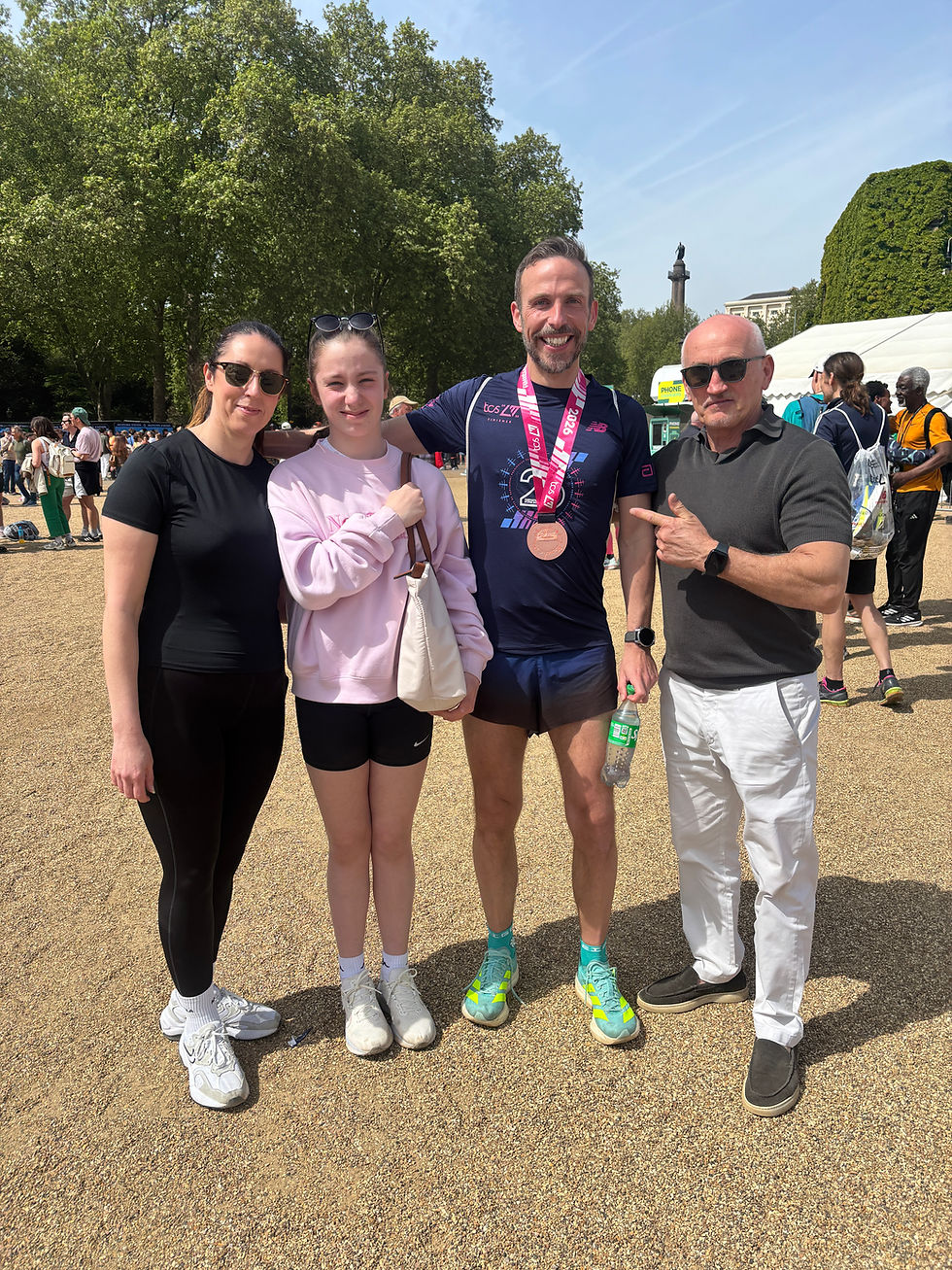
My London Marathon experience is never complete without my amazing family support crew, who put up with my early alarms, smelly shoes in the hall, moaning about niggles, rice for breakfast at the weekends and endless piles of sweaty gear. This was our 4th London as a family, and it’s become a tradition to grab a nice photo at the end, taken by a random stranger.
I spotted a group of ladies nearby and asked if one of them wouldn't mind taking a quick snap of us.
Out of nowhere, from just outside my line of sight, boxing legend Barry McGuigan appeared! He heard the Northern Irish accent, immediately recognised it, and wandered over for a chat. He ended up taking the photo for us and even jumped in for one alongside us. Absolute legend. Such a brilliant memory.
What's Next? Chasing Sub-2:40
So, with a 2:41:10 in the bag, I'm inevitably looking at the clock again. That sub-2:40 barrier is tantalisingly close but I’m now in my 46th lap of the sun and 8th year running. Where do I find those missing 72 seconds? Next time around, in September I think it’s maybe going to come down to lifestyle tweaks and the 1% gained through sleep, nutrition, mentality and race preparation.
I’m hoping to put together another solid block and take a swing at sub-2:40 at either Berlin in September or Valencia in December.
The marathon journey keeps going!


Comments